An honest guide to dental implants

Know what should happen before you sit in the chair.

A dental implant is a small titanium root placed in your jaw to hold a new tooth. Done right, it lasts decades. The difference between "done right" and "done fast" is whether your dentist follows every stage — and tells you the truth at each one.

This is general patient education, not medical advice. Your treatment depends on your own scans, bone, and health. Always decide with a qualified dentist who has examined you.
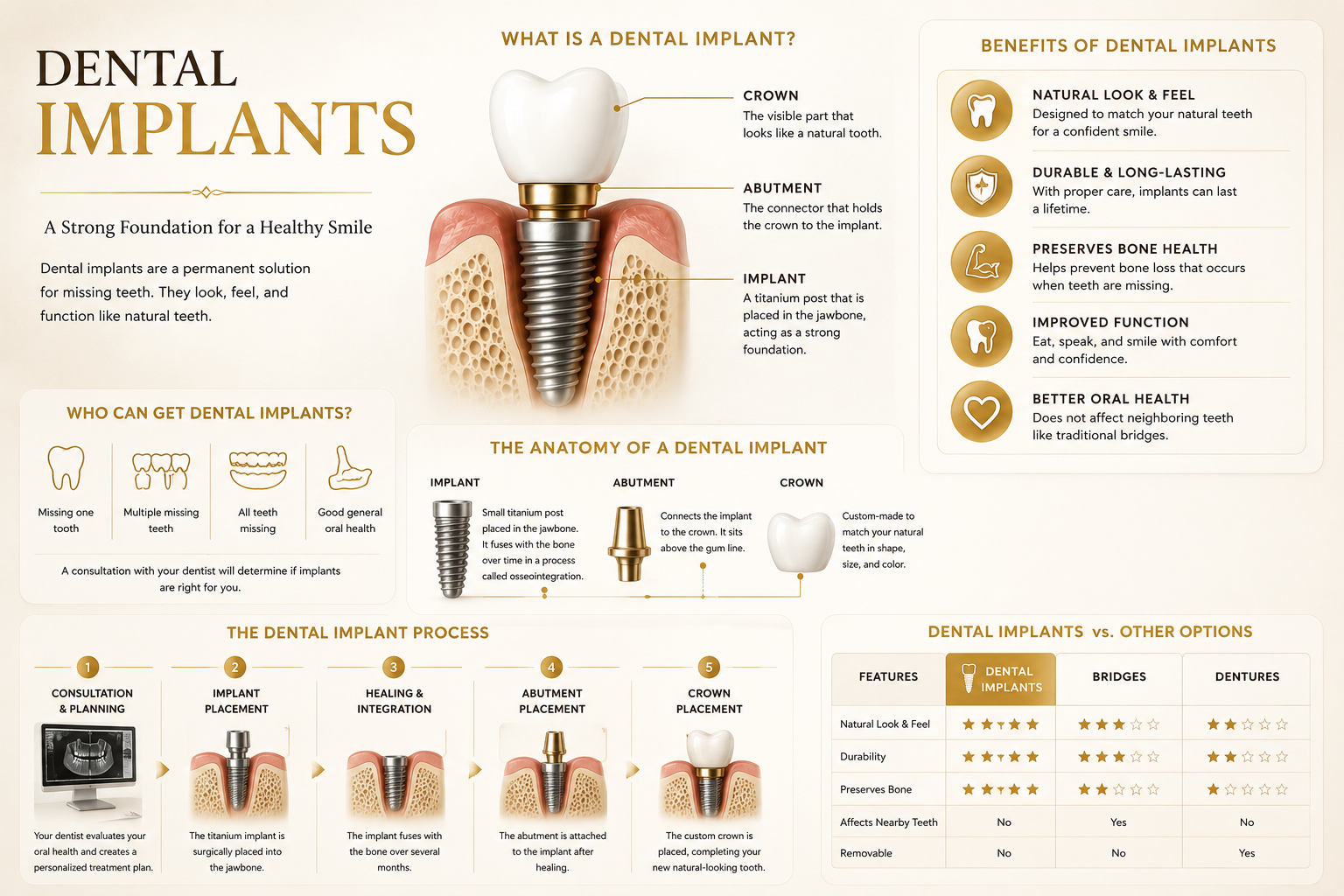
Dental implants infographic: what a dental implant is (crown, abutment, titanium post), who can get them, the anatomy of an implant, the five-step process, benefits, and how implants compare to bridges and dentures.
Dental implants at a glance — anatomy, the five-step process, benefits, and how they compare to bridges and dentures.
The Journey · 01

Every stage your dentist should walk you through.

A proper implant is not one appointment. It is a sequence — and skipping steps is where things go wrong. Here is what a careful dentist does, in order, and what you should expect to see.

STAGE01
Day 1

Consultation & Diagnosis

Visit 1 · 30–60 min

Before anything is drilled, the dentist needs to understand your mouth, your bone, and your health. A rushed exam here is the single biggest warning sign.

  • A full medical history — diabetes, smoking, blood thinners, and bone medication all affect implants.
  • A clinical exam of gums, remaining teeth, and bite.
  • A 3D CBCT scan (not just a flat X-ray) to measure bone height, width, and the position of nerves and sinuses.
  • A written, itemised treatment plan and cost estimate — including the implant brand they intend to use.
Red flagA dentist who promises an implant "today" without a 3D scan or any discussion of your bone is cutting corners that matter.
STAGE02
Day 1–7

Planning & Bone Assessment

Between visits

Using the 3D scan, the dentist plans exactly where the implant goes — angle, depth, and size. This is also where they decide whether you have enough bone, or whether you need to build some first.

  • Digital placement planning so the implant avoids nerves and sinuses.
  • An honest answer on whether you need a bone graft or sinus lift before placement.
  • A surgical guide (a custom 3D-printed template) for accurate, predictable placement in most modern practices.
Ask this"Do I have enough bone for this implant, or will I need a graft? Show me on the scan."
STAGE03
Day 7–14

Implant Placement (Surgery)

Visit 2 · 1–2 hrs · local anaesthetic

The titanium implant is placed into the jawbone. It is a minor surgery, usually painless under local anaesthetic, and far less dramatic than people fear.

  • Done in a clean, sterile setup with proper instruments.
  • A healing cap or temporary placed so the gum heals around it.
  • Clear aftercare instructions and a follow-up date.
  • You should be told the exact implant brand and reference number placed in your mouth — keep this on record.
Why the record mattersIf anything ever needs servicing years later, the next dentist needs to know the exact system. Reputable brands make this easy.
STAGE04
Week 2–16

Healing & Osseointegration

8–16 weeks · the waiting part

This is the science that makes implants work: your bone grows and fuses to the titanium, a process called osseointegration. It cannot be rushed. Quality implants are designed to speed this up safely — but biology still sets the clock.

  • You go home with a temporary tooth or gap (depending on the location).
  • The dentist may check healing with a follow-up scan or stability test.
  • "Same-day teeth" exist but are only suitable in specific, carefully selected cases — not a universal shortcut.
STAGE05
Month 4–5

Abutment & The Crown

Visit 3–4 · the new tooth

Once the implant has fused, a connector (the abutment) is fitted, an impression or digital scan is taken, and your final crown — the visible tooth — is made and attached.

  • A custom crown matched to the shade and shape of your other teeth.
  • A bite check so the new tooth doesn't sit too high or low.
  • Confirmation that the crown is secure and you can chew normally.
STAGE06
Lifelong

Maintenance & Warranty

For life

An implant is for keeps only if it is cared for. Good practices set you up for the long term rather than waving goodbye after the crown.

  • Instructions on cleaning around the implant (special floss / interdental brushes).
  • Regular professional cleanings to prevent peri-implantitis (gum disease around the implant).
  • A clear warranty in writing — what's covered, for how long, and by whom.
Ask this"What warranty comes with this implant and crown, and what would void it?"
From Real Records · 02

Five things that separate a real implant case from a sales pitch.

These aren't from a brochure. They're the details that show up in a properly documented implant treatment — the things a careful clinic records, and most patients never know to look for.

A real implant comes with a barcode sticker

Every genuine, branded implant ships with a peel-off label showing the manufacturer, reference number, diameter, length, surface type, lot number and expiry. A good clinic peels this sticker straight into your file. It is your permanent proof of exactly what is in your jaw — and what any future dentist will need to service it.

Ask for it: "Please put the implant sticker in my records."

The implant is placed to a torque value

When the implant is screwed into bone, the dentist measures the final tightness — recorded in Ncm (newton-centimetres). This "insertion torque" reflects how stable the implant is from day one, and it helps decide whether a tooth can be loaded early or needs to heal first. It's a number worth having in your notes.

Typical record: "Final torque 25 Ncm"

The healing abutment is its own scheduled step

After placement, the implant is often left to fuse with the bone for weeks or months before the next part — the healing abutment — is fitted. Seeing a real gap in the calendar (for example, implant placed in April, healing abutment scheduled for July) is normal and reassuring. It is the biology of osseointegration, not a delay.

This is why "teeth in a day" isn't the default

An implant is rarely a standalone job

In real mouths, the implant usually sits inside a bigger plan — a root canal on a neighbouring tooth, a core build-up, a temporary bridge to fill the gap while the implant heals. A good dentist treats the whole picture in sequence, not one tooth in isolation. Expect a roadmap, not a single appointment.

Ask: "Show me the full sequence and the timeline."

The brand choice is a real, priced decision

Premium German/Swiss and value Korean systems are often quoted side by side, with a genuine price gap between them. Multiplied across several implants, that difference adds up — which is exactly why it deserves a clear-eyed decision rather than a default. See the price guide below for realistic numbers.

More on this in "German vs Korean" ↓
The Big Decision · 03

German vs. Korean implants — the honest version.

This is the question almost every patient eventually faces, usually framed as "premium vs. budget." The real picture is more nuanced: both can be excellent, and the right answer depends on your case, your dentist's skill, and how long you plan to keep your teeth.

🇩🇪 German / Swiss tier

The Premium Standard

e.g. Straumann (CH), Nobel Biocare, Bredent / SKY
Track record
Decades of long-term clinical studies. The data behind "implants last 20+ years" largely comes from these systems.
Cost
Higher — often 1.5× to 3× the Korean equivalent per implant.
Availability of parts
Excellent worldwide. Almost any dentist anywhere can service or repair them years later.
Best for
Complex cases, compromised bone, front teeth, and people who want the most-studied option and may move/travel.
vs
🇰🇷 Korean tier

The Value Leader

e.g. Osstem, Dentium, DIO, MegaGen
Track record
Strong and growing. Osstem is one of the world's largest implant makers; widely used across Asia with solid clinical results.
Cost
Significantly lower — makes full-mouth or multiple implants far more affordable.
Availability of parts
Very good in Asia and increasingly global, but check that parts are easy to source where you live.
Best for
Straightforward cases, multiple implants on a budget, and patients treated by a dentist experienced with the system.

The honest truth

For a routine single implant in healthy bone, a good Korean system placed by a skilled dentist can perform just as well as a German one. The brand matters less than the surgeon's hands and your aftercare.

When to pay for German

Spend up if your case is complex — front teeth (aesthetics), grafted or thin bone, full-mouth reconstructions, or if you value the deepest long-term research and global serviceability. It is insurance, not vanity.

The trap to avoid

Beware of unbranded or "no-name" implants quoted at suspiciously low prices. The risk isn't the country of origin — it's an untraceable system with no parts and no warranty. Always know the exact brand.

What actually decides success

Studies consistently show the dentist's experience, correct planning, and your gum care influence long-term success more than the implant brand. A great brand placed poorly will still fail.

Price Guide · 04

A standard price guide, in plain numbers.

Indicative prices for implant treatment and related dental work at a private hospital level in India, shown in rupees with US dollar, euro and pound conversions. Use these as a reference point when you receive your own estimate — not as a fixed quote.

Dental implants — per implant
German / Swiss implant premium tier (e.g. Straumann)
₹48,588$585 · €540 · £463
Korean implant value tier (e.g. Osstem)
₹40,020$482 · €445 · £381
Implant PFM crown the visible tooth on the implant
₹10,008$121 · €111 · £95
Crowns & caps — per unit
All-metal crown
₹6,096$73 · €68 · £58
PFM crown — Tilite (nickel-free)
₹10,800$130 · €120 · £103
PFM crown — CAD/CAM
₹13,668$165 · €152 · £130
Zirconia crown / onlay most aesthetic, metal-free
₹19,728$238 · €219 · £188
Supporting treatment
Root canal therapy posterior tooth
₹8,592$104 · €95 · £82
Posterior core build-up
₹3,228$39 · €36 · £31
IOPA X-ray per film
₹300$4 · €3 · £3

A complete single-implant tooth = implant + crown. German tier ≈ ₹58,596 ($706 · €651 · £558); Korean tier ≈ ₹50,028 ($603 · €556 · £476). Prices vary by city, clinic, bone condition, and whether extras like bone grafts are needed. Always confirm an itemised, all-in quote before starting.

Foreign-currency figures are indicative conversions from INR and will shift with exchange rates.

No Marketing · 05

Three things the brochure won't tell you.

/ 01

The brand is on the box, not in your jaw's biology.

Your healing, your smoking habits, and your diabetes control affect the outcome far more than the logo. Cheaper isn't riskier if the fundamentals are sound.

/ 02

"Lifetime warranty" usually covers the screw, not your time.

Manufacturer warranties often replace the failed part for free — but you still pay for the dentist's labour to redo it. Read what's actually covered.

/ 03

Same-day teeth are real, but rarely for everyone.

Immediate-load implants need ideal bone and case selection. If you're offered them by default, ask why your specific case qualifies.

Take This With You · 06

Six questions to ask before you say yes.

Screenshot this. A confident, ethical dentist will welcome every one of these. Hesitation or annoyance is itself an answer.

01
Which exact implant brand and model will you use?And why this one for my case specifically?
02
Can I see my 3D CBCT scan and my bone levels?Show me where the implant will sit relative to the nerve.
03
Will I need a bone graft or sinus lift?If so, what does that add in time and cost?
04
How many of these have you placed, and your success rate?Experience with this specific system matters.
05
What is the total, all-in cost — including the crown?Beware quotes that exclude the abutment or crown.
06
What warranty do I get, in writing, and what voids it?Get the brand, terms, and duration on paper.